"You exaggerate everything": how to recognize toxic communication and protect your own boundaries
NUJU8 minutes of reading
Share:
. ..Let's imagine that we took a hot cup in our hands. It burns, but for some reason we continue to hold it: we intercept it more conveniently, we tolerate it, we hope that it will get easier soon. Although the easiest solution is to simply put it. In communication, we often behave in the same way. We stay in a conversation that exhausts us, explain our position again and again, make excuses, try to convince the interlocutor or earn his approval. And when the dialogue finally ends, we mentally return to it for a long time: what was said wrong, how should we have responded, why couldn't we stop in time? Why does this happen? How to understand that we have toxic communication, and not just a difficult conversation or a simple disagreement? And how to protect one's own boundaries without resorting to aggression in response?
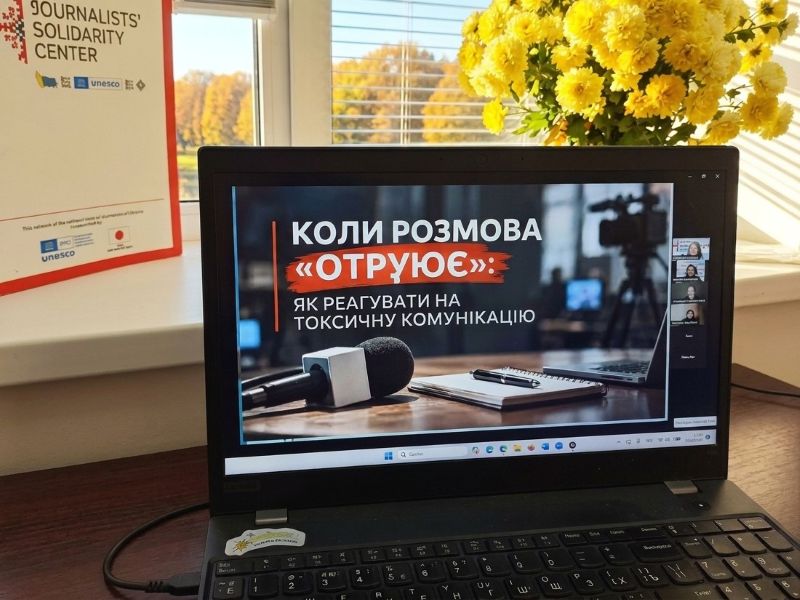
This was discussed by the participants of the online training "When the conversation is "poisonous": how to react to toxic communication" , which was held by the Dnipro Center of Journalistic Solidarity of NSHU together with Natalia Voytovych - psychologist, journalist, media expert, coordinator of the Lviv area of the West Ukrainian Center of Journalistic Solidarity of NSHU.
- Sometimes it happens that after an ordinary conversation, as if nothing special happened, and we feel emotional devastation. I feel like a lemon with all the juice squeezed out of it. The interlocutor has already left, but I still continue the conversation in my head, - described the feeling familiar to many.
At the same time, Natalia Voytovych emphasized: not every conversation we don't like is toxic. And not every person who disagrees with us is a manipulator.
In a professional environment, it is impossible to completely avoid disputes. Disagreement or criticism does not in itself indicate manipulation or pressure. It is important to pay attention to exactly how the interlocutor expresses his position. Evaluate not a single phrase or word, but the nature of the interaction in general: whether there is an opportunity to express one's own opinion, whether personal boundaries are respected, whether certain behavior is repeated.
How psychological pressure manifests itself
One of the mechanisms of psychological influence is gaslighting - behavior in which a person is systematically forced to doubt his own memory, perception or adequacy of his reactions.
It can begin with, at first glance, ordinary phrases: "I didn't say that," "You misunderstood everything," "You thought so," "You react too emotionally." When such statements are repeated, a person begins to trust his own observations less and less and rely more on the interlocutor.
However, a one-time argument is not proof of gaslighting. We can all make mistakes, forget details, interpret events differently. The repetition of the behavior and its consequences for the affected person are decisive.
Another common tool of psychological pressure is devaluation . It manifests itself, in particular, when a positive result is explained by the appearance, character, age or weakness of other participants, actually denying the efforts of the person himself. Systematic devaluation gradually reduces self-confidence and increases the need for approval - even when a person is objectively doing a good job.
During the training, special attention was paid to situations where they try to influence the interlocutor's decision due to guilt , fear of losing a relationship, or a sense of duty.
"After everything I've done for you...", "If you respect me, you'll agree", "You yourself make me behave like this" - such and similar statements can be used to shift responsibility for one's own actions to another person.
The psychologist drew attention to the so-called punishment of silence . It is about a situation when a person demonstratively stops communication in order to achieve a concession or an apology. It is important to distinguish between the deliberate use of ignoring as a method of pressure and the normal need to pause. After all, temporarily stopping the conversation can help reduce tension. Instead, prolonged silence with the aim of punishing the interlocutor already becomes part of manipulative behavior.
Why is it so difficult to stop in time?
People are not always ready to stop talking, even when it causes harm. As noted by Natalia Voytovych, one of the reasons may be the fear of conflict . A person agrees, remains silent or begins to make excuses so as not to cause even greater dissatisfaction. Another reason is the need to be liked . It is difficult to refuse, when it seems that after "no" the interlocutor will be offended, disappointed or end the relationship.
This is where the metaphor of a hot cup is again appropriate: we understand that it burns, but we are in no hurry to let it go. In communication, we can also remain in an uncomfortable situation, trying to prove something or get approval. Therefore, it is important to learn to recognize your own boundaries before the tension becomes excessive.
During the practical part, the trainer offered the participants the exercise "My button" to help identify vulnerable places that interlocutors can influence during a conflict.
Participants had to answer four questions in writing:
What words hurt me the most?
What makes me make excuses?
When is the hardest time for me to say no?
What reaction of the other person do I fear the most?
Being aware of these reactions helps you spot the moment when the conversation starts to get out of control. If we know which words trigger a strong emotional response, it is easier for us to pause and not react automatically.
Changing habitual patterns of behavior is not easy, so you should start with small steps: notice your own emotions, analyze difficult conversations, gradually practice new ways of responding.
How to protect your boundaries: three practical techniques
After discussing the psychological mechanisms, the participants analyzed specific methods of protection. Specifically, three techniques that can be used depending on the situation.
"Grey rock" implies a minimal emotional reaction. If the interlocutor tries to cause irritation or get involved in an argument, the answer should be short, neutral and without unnecessary explanations. For example : "I heard you", "I understand your position", "I have nothing more to add" . This is how we do not continue the conflict into which they are trying to drag us.
"Rated record" is a calm repetition of one's own position without new arguments and excuses. For example, if a coworker insists that you take on an extra task, even though you've already explained that you don't have the option, repeat, "I won't be able to do it today." If the pressure continues, the answer remains the same: "I know it's important, but I can't do it today." The purpose of the technique is to consistently mark the boundary without turning the refusal into an endless discussion.
"I-message" helps to talk about one's own feelings and needs without blaming the interlocutor. Instead of "You keep interrupting me and never listen," it's better to say, "It's hard for me to finish a thought when I'm interrupted. Please let me negotiate." This wording specifies the problem and explains what kind of change in behavior we expect.
A calm tone, concise wording, and a willingness to pause if the conversation becomes too emotional remain important.
Phrases that will help protect your own boundaries
Separately, the participants analyzed typical responses that may contain devaluation or psychological pressure, and looked for ways to respond to them without aggression and unnecessary excuses.
For example, the phrase "You don't understand anything" can be answered: "Please explain what exactly you disagree with." If the interlocutor says: "You always complicate everything" , turn the conversation to specifics: "Let's consider a specific situation. What exactly do you think was complicated?”
At the request "You must do it", you can offer to agree on tasks, deadlines and responsibilities. If you hear: "It is impossible to work with you" , ask to name a specific problem that needs to be solved. And to the line "Don't ask stupid questions" calmly answer: "I need an answer to a specific question."
If the interlocutor insists: "A normal person would agree" , it is worth reminding that people have different views and the right to their own decision. And for the request "You must help me" - explain exactly what kind of help you are able to provide and where your possibilities end.
- When we are devalued, we try to return to the facts. We can say: "I am ready to discuss specific comments," Nataliya Voytovych explained.
For journalists, a kind of "pocket set" of phrases that help navigate a tense conversation can be especially useful:
To bring the conversation back to the facts: "What exactly are the facts that support your point?"
To stop the depreciation: "Please talk about my work, not judge me personally."
In order not to accept imposed guilt: "I am ready to discuss my part of the responsibility."
To stop the pressure: "I will not make decisions under pressure."
To mark the boundary: "I will continue the conversation if we communicate correctly."
To end the contact: "In this format, I will not continue the conversation."
The general algorithm of communicative self-defense is to return to the facts, pause if necessary, not accept the imposed framework of the conversation, mark one's own boundaries and, if necessary, end the dialogue.
It is also worth considering that no technique guarantees that the interlocutor will change his behavior. These tools help you primarily manage your own participation in the conversation and choose how to respond to pressure.
I have the right to my own boundaries
Summarizing the training, the psychologist asked the participants to complete three sentences: "I no longer have to or do not have to...", "I can...", "I have the right...".
Among the answers were the following: the right not to make excuses for the fact of one's position, to pause, to define boundaries and to choose an acceptable communication format.
We cannot always influence the words and actions of other people, but we can gradually change our own reactions and ways of protection.
At the same time, it is important to remember that if humiliation, threats or harassment are of a systematic nature, relevant cases should be recorded - messages, screenshots, dates, links and other materials that can confirm the facts of violations should be kept.
In a professional environment, a problem can be reported to an editor, management, or a professional organization. If necessary, you should seek legal or psychological help. At the same time, the documentation methods must be legal and safe. If there is a risk of physical violence or harassment, protection is the priority, not continuing the conversation.
The event took place within the framework of the project "Expansion of strategies, networks and tools in the field of mental health and prevention of burnout for civil society in Ukraine" together with Araminta gUG and the Action Office.
***
The Network of Journalist Solidarity Centers is an initiative of the National Union of Journalists of Ukraine, implemented in cooperation with the International and European Federations of Journalists, UNESCO, and with the support of the people of Japan. Our main goal is to help media workers working in Ukraine during the war. The centers work in Kyiv, Kharkiv, Zaporizhzhia, Dnipro, Lviv and Ivano-Frankivsk. This project is part of UNESCO's broader efforts to support the safety of journalists and freedom of speech in Ukraine.
The contact numberof the Center for Journalistic Solidarity in Dnipro is 050 919 84 79 ( Natalya Nazarova , coordinator of the Dnipro Center).
Liana Okhrymenko, Dnipro State University
The primary source is the National Union of Journalists of Ukraine
The site uses cookies. The necessary ones are required for its operation (entering the cabinet, saving your choice). We enable analytical and marketing data only with your consent - in accordance with the Laws of Ukraine "On Personal Data Protection" and "On Electronic Communications". Consent can be changed or withdrawn at any time. For more details, see the Cookie Policy and Privacy Policy .