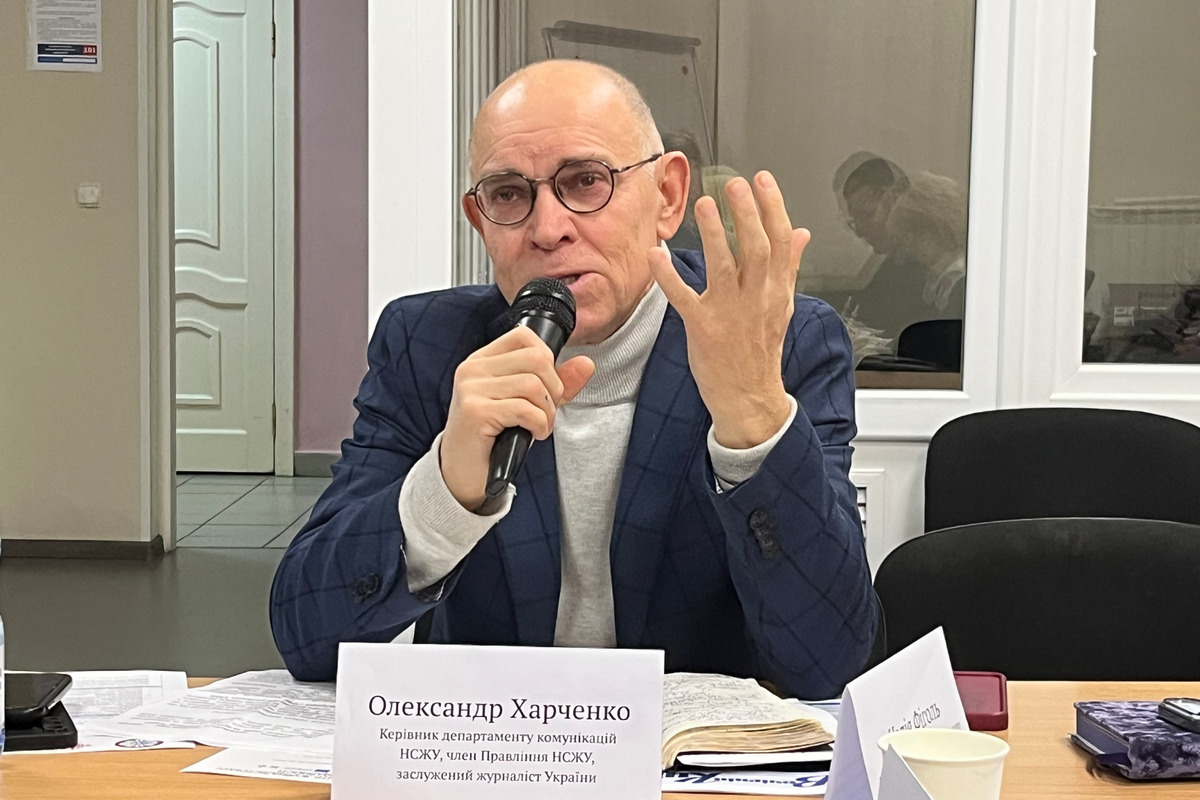
Who is interested in a newspaper with a circulation of 500–600 copies somewhere in Sumy Oblast? Oleksandr Kharchenko, the head of the communications department of the NUJU, a member of the board of the union, is convinced that her stories can touch the reader in Stockholm, Madrid or Rome.
At a roundtable discussion on "Media and the Publishing Business in Wartime" at Grinchenko University, he compared it to an American movie where the hero wants his Christmas-lit house to be seen from space.
- This may be a crazy idea, - he admitted, - but just as the house of the eccentric hero Dani de Vito was seen from space, the experience of the Frontline Press project shows that it is possible.
"Frontline Press" is implemented by NUJU together with the Swedish Media Business Association (Tidningsutgivarna). The program supports 25 newsrooms from Kharkiv Oblast, Sumy Oblast, Donetsk Oblast, Zaporizhzhia, Kherson Oblast and Dnipropetrovsk Oblast. Together with journalist Vadym Petrasyuk, Kharchenko is the mentor of the project: they reread hundreds of texts from front-line newspapers and help bring the best of them into international orbit.
Oleksandr Kharchenko calls the main challenge "compassionate burnout" of the Western audience. Europeans still sympathize with us, but they have already developed an immunity to dry statistics about arrivals and burned hectares. Therefore, the main rule of mentors is to go from statistics to a specific person.
- We are not "whining", but courageously defending the country, - explained Oleksandr Oleksandrovich, why the Western reader appreciates stability.
Mentors urge to write not about the "destruction of the agricultural sector", but about a farmer from Sumy Oblast who helped fellow villagers "listen to the sky", because anxiety comes later than danger. Not with general phrases about "volunteering", but about a designer from Sumy, whose "military embroidery" became the front aid headquarters 30 kilometers from the border with Russia. About the driver of the Sumy trolleybus: after the "shaheda" was hit, she provided first aid to a passenger, drove the damaged car to the depot, and the next day she returned to the route. About basketball in Mykolaiv, where under constant fire Super League matches gather more spectators than in Kyiv.
Oleksandr Kharchenko explained what makes such stories global through several techniques.
Universal cultural codes. A fighter with the call sign "Dante" lost his father in battle and continues to fight, while his wife, whom he calls Beatrice, removes fragments from his body with tweezers at home. To understand this story, you don't need to know where Gulyaipole is.
Details. A fighter who survived for weeks in the basement of an occupied village thanks to a few jars of jam. A volunteer who returned under fire after a woman and her two Dobermans, who did not fit in the car.
The contrast of civilization and barbarism. A scientist from Askania-Nova was declared a "bioterrorist" by the FSB because of bird migration maps. After passing 53 roadblocks, he left for the Lviv Region and now tells how tanks destroy the virgin steppe.
The editorials themselves are part of history. Each publication is accompanied by a note on media: relocation, work 5-30 kilometers from the enemy, printing newspapers for villages without communication. This explains to a foreigner that the very appearance of such a text is a manifestation of journalistic heroism.
Stories from the communities are translated into English, published on the English-language version of the NUJU website, and submitted for publication to Western editors, in particular Swedish. They were offered to make front-line newsrooms their collective own correspondent: this is how Western media save on business trips and insurance.
- And who better to tell the story than a person who lives in hell, in the epicenter of this war? - says Oleksandr Oleksandrovych.
According to him, the project provides more than financial support. Newsrooms become multimedia and implement their own projects, and the world receives live stories from Ukraine. Oleksandr Kharchenko hopes that such compassionate burnout will be replaced by interest, empathy and help for Ukraine.
Information service of NUJU