"Everyone agreed" - but really? How the group influences decisions
NUJU7 minutes of reading
Share:
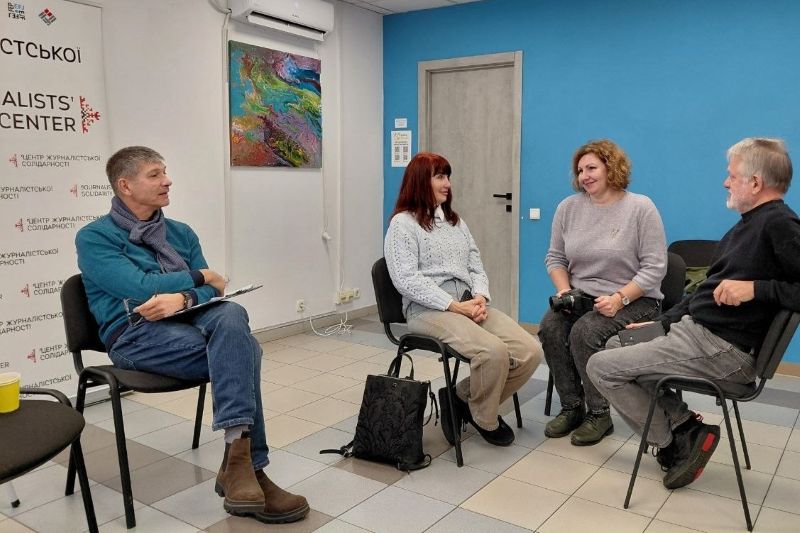
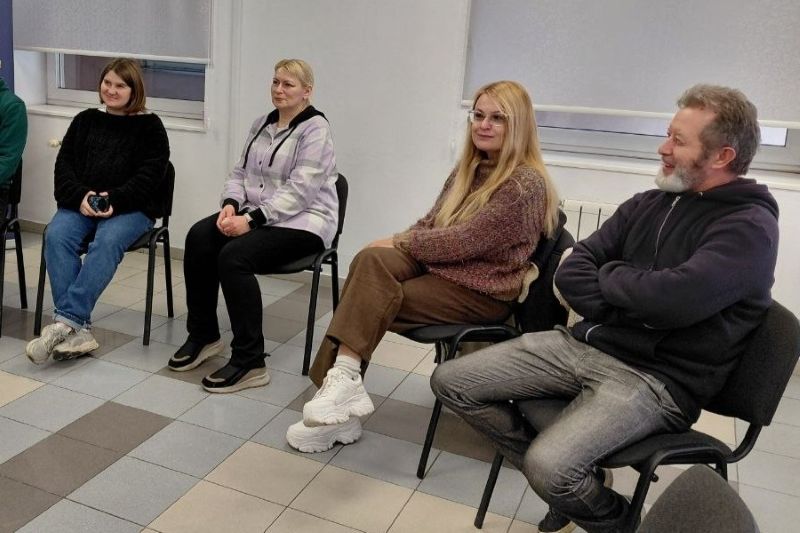
Why do people adapt to the behavior of others, follow unwritten rules and sometimes support decisions that no one really wanted? How do such rules arise? And why is it that sometimes one awkward line is enough for a group to reconsider a decision that a moment ago seemed unanimous?These mechanisms of group influence, hidden norms and the ability to maintain one's own position were discussed by the participants of the psychological training "When the editorial team thinks for you: how the group imperceptibly changes our decisions and behavior", organized by the Dnipro Center of Journalistic Solidarity of the NUJU. The meeting was conducted by the psychologist and trainer of the NGO "Voice of Pro" Oleksandr Makuha.
At the beginning of the training, he brought up a story known as the Abilene Paradox. The family decided to go for a walk a hundred kilometers away. Hot day, dusty road, car without air conditioning. The trip turned out to be exhausting, and everyone returned home tired and irritated. And later it turned out: in fact, no one wanted to go! Everyone agreed, because they thought that this was what the others wanted, and did not want to spoil their mood.
This happens not only in families, but also in work teams - for example, during editorial meetings, when silence is taken as consent, and doubts remain unspoken.
How we adapt to the group
This topic is particularly relevant for journalists. After all, the editorial team is a team that makes decisions about topics, sources of information, coverage of events, publication of materials, etc. But each of these decisions can be influenced not only by professional standards and facts, but also by relationships within the team.
One of the mechanisms of group influence is that a person changes his behavior by focusing on others, even when no one asks him to do so. Alignment in itself is not a problem, because it helps to cooperate, coordinate actions and achieve a common goal. However, difficulties arise when a person does not notice that his decisions are determined by the behavior of the group.
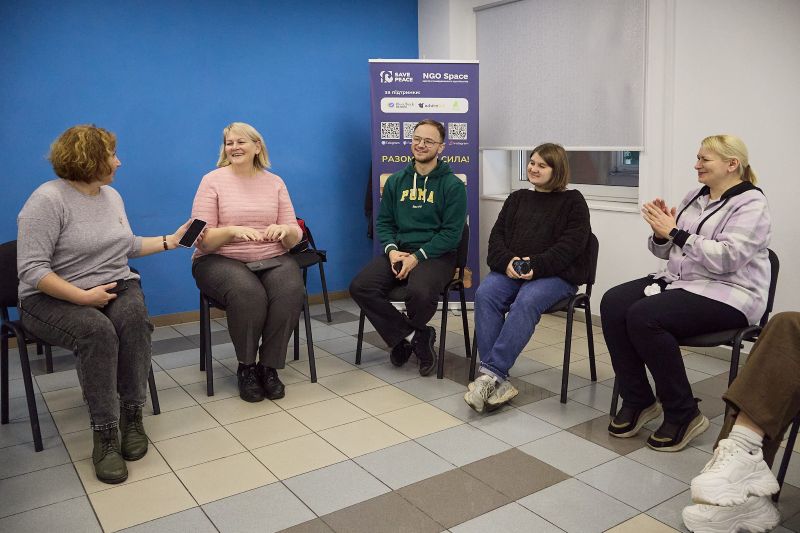
During the training, the participants had the opportunity to see this in practice. In particular, having united in small teams, they came up with names and slogans for them, and then convinced others that their team was the best. Such an exercise demonstrated how quickly a sense of belonging to a group and a desire to support it emerges, even if its members were strangers to each other just a few minutes ago.
Unwritten rules that no one set
Group norms are also relevant - "unwritten" rules of behavior that exist in the team, although no one has established them. Respond to work messages even on the day off, do not leave the workplace before the manager, follow a certain order of greetings or behave as is established among colleagues.
At first glance, the rules seem like normal elements of corporate culture. But who exactly made them? It often turns out that no one is. A person comes to a team and observes: how do colleagues greet each other? Do they have lunch together? Do they linger after the end of the working day? How do they react to disagreement?
- When I am in a group, I always scan what is relevant in this group, - explained Oleksandr Makuha . - And even if no one told me about it, a person constantly imagines what is appropriate and what is not in this group.
A situation arises when team members support behavior that no one consciously chose. According to the trainer, this is another mechanism of group influence - an idea of the reaction of other people. We can be guided not by the requirements of the team, but by our own assumptions about these requirements.
Another exercise was devoted to how people adapt to group behavior. First, each participant tapped their own rhythm, and then everyone was invited to try to synchronize. Gradually, the rhythms began to harmonize: people listened to each other and adjusted their own actions. At the same time, no one appointed a leader or determined who should be repeated. The participants themselves were looking for a common rhythm.
After the exercise, the coach asked the participants to remember who they were targeting when they changed their own rhythm. Thus, practical experience helped to pay attention to how we involuntarily begin to adapt to others.
Silence is not consent
Particular attention was paid to the adoption of collective decisions. After all, sometimes the group perceives the absence of objections as support, although in reality the silence has various reasons: insecurity in the position, fear of the manager's reaction, reluctance to argue or the belief that the decision has already been agreed upon. In this way, an imaginary unanimity is formed.
- When everyone sits in silence, there is a very high risk that the decision was not discussed at all, - the coach noted.
But a person who asks uncomfortable questions and violates the so-called unanimity does not necessarily disturb the group. On the contrary, it can help see a problem that everyone else has turned a blind eye to.
When responsibility dissolves in the group
They also analyzed another psychological phenomenon - the diffusion of responsibility: a situation where a person is less inclined to show initiative if there are many other people nearby.
The coach likened it to asking for help. It seems that among a large number of people, the victim will quickly find someone who will help. However, the opposite happens, because everyone expects someone else to intervene.
Therefore, in a critical situation, you should not turn to the crowd, but to a specific person. The principle also applies to work processes. Collective responsibility requires division of tasks. Especially when it comes to security, information reliability or decisions with potentially serious consequences.
Do we really have a choice?
Another mechanism of influence was explored by participants through a limited-choice exercise. The psychologist proposed a situation in which you need to choose one of two options. At first glance, a person has freedom of decision: he can agree to one option or prefer another.
- You freely choose between two solutions. But your freedom is limited, he explained.
Similar situations arise in editorial work. For example, a journalist can be offered only two options: to publish the material immediately or to refuse it altogether. But are there really no other possibilities? To get beyond the imposed choice, you need to ask questions about the task: why are we considering only these options? Who defined the limits? Can we suggest another solution? What goal are we trying to achieve?
Such questions help to separate the real circumstances from the conditions accepted by the group. After all, an editorial decision should be based on facts, risk assessment and adherence to standards, and not just on trust or authority.
How to maintain your own position in the team
One of the main conclusions was the distinction between group norm and conscious agreement.
- A group norm is a group norm because no one prescribed it. If I ask and we agree, it's already an agreement. These are very different things, Oleksandr Makuha emphasized.
The difference is awareness. When a person repeats a certain action only because others do it, he does not understand its purpose. When the participants have discussed, clarified the reasons and agreed to follow a certain rule, they agree on a conscious decision.
So how does one remain part of a group without losing the ability to make independent decisions? Here are some practical recommendations:
Clarify the position of colleagues. Silence should not automatically be taken as consent. It is better to ask if there are comments, doubts or alternative suggestions.
Distinguish between rules and assumptions. If something has "always been done this way" in the team, it is worth finding out whether there is a corresponding agreement and why it is needed.
Check selection limits. When only two options are offered, one should ask whether there really are no other options.
Separate facts from expectations. It is important to understand whether the decision is based on verified information or on assumptions about what others think.
Do not perceive disagreement as a threat. A reasoned objection can help the team catch a mistake before it has consequences.
Agree on responsibility. If the decision is collective, it is necessary to understand who is responsible for its implementation and verification of the result.
A group is able to support, help work more efficiently and find solutions that are difficult to achieve alone. At the same time, the team can imperceptibly limit the choice if its members stop asking questions and focus only on the behavior of the majority.
Therefore, one of the most useful habits is not to rush to agree with a decision just because it seems generally accepted. Sometimes it is enough to ask: "Why did we decide to do this?" in order to find out that, in fact, no one has decided this before.
The training took place within the framework of the project "Expansion of strategies, networks and tools in the field of mental health and prevention of burnout for civil society in Ukraine" in cooperation with Araminta gUG and NGO "Office Diy".
The Network of Journalist Solidarity Centers is an initiative of the National Union of Journalists of Ukraine, implemented in cooperation with the International and European Federations of Journalists, UNESCO, and with the support of the people of Japan. Our main goal is to help media workers working in Ukraine during the war. The centers work in Kyiv, Kharkiv, Zaporizhzhia, Dnipro, Lviv and Ivano-Frankivsk. This project is part of UNESCO's broader efforts to support the safety of journalists and freedom of speech in Ukraine.
The contact numberof the Center for Journalistic Solidarity in Dnipro is 050 919 84 79 ( Natalya Nazarova , coordinator of the Dnipro Center).
Liana Okhrymenko, Dnipro State University Photo by Viktor Kachanov and Svitlana Iotova
The primary source is the National Union of Journalists of Ukraine
The site uses cookies. The necessary ones are required for its operation (entering the cabinet, saving your choice). We enable analytical and marketing data only with your consent - in accordance with the Laws of Ukraine "On Personal Data Protection" and "On Electronic Communications". Consent can be changed or withdrawn at any time. For more details, see the Cookie Policy and Privacy Policy .