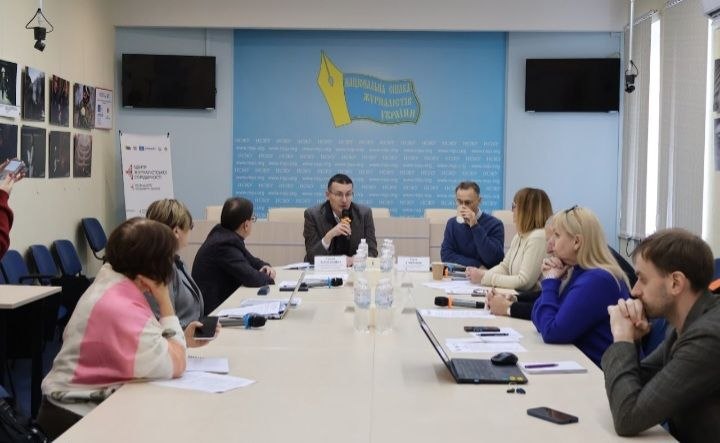
How to ensure that adult education in the Ukrainian information space is not only a reason for short news about another course or educational event, but a topic for a deep journalistic conversation about people, communities and the restoration of the country? The round table "Adult education in the focus of the media: from informing to social changes" organized by the National Union of Journalists of Ukraine together with the Ukrainian Association of Adult Education and DVV was devoted to this issue. International in Ukraine.
Adult education in the conditions of war, demographic and socio-economic changes is gaining more and more importance. Especially if you look at it from the angle of the post-war recovery of Ukraine. Lifelong learning is connected with professional adaptation of people, development of technologies, social integration and sustainability of communities. It is important that this sphere, as noted during the event, should be represented as widely as possible in the Ukrainian media space.
One of the central issues of the discussion is how to move from episodic coverage of individual educational initiatives to a systematic journalistic conversation about trends, problems and social results of adult education.
The head of the National Union of Journalists of Ukraine, Serhiy Tomilenko, noted that adult education is already present in journalistic materials, but often not as an independent topic, but in the context of broader social processes - employment, social adaptation, veteran policy, community development.
– The media draws attention to educational courses, opportunities for professional development, and presents educational initiatives for adults. But maybe they don't always show the changes that take place thanks to the inclusion of a person in the educational service, says Serhii Tomilenko. - Important stories, how training really changes a person, a veteran, how socialization takes place, success comes. For this, it takes some time to distance from the moment of learning, certain educational services to the result, how new knowledge is embodied.
At the same time, the head of the NUJU drew attention to the realities of the work of Ukrainian media workers. Due to the war and economic difficulties, the workload on journalists has increased significantly: what used to be done by a full-fledged editorial office, today is often done by one person. Separately, Serhiy Tomilenko emphasized the importance of continuous professional training for journalists. According to him, the media must remain the leaders of digital transformations and cannot "preserve" already acquired knowledge.
- We cannot ignore innovations, we have to lead them and, of course, use them responsibly," emphasized Serhiy Tomilenko.
About the role of adult education today and why it is important to make this sphere more visible to society, Larisa Luk'yanova , head of the board of the Ukrainian Association of Adult Education, told. She noted that a number of webinars and educational events for journalists were held during the year, thanks to which the media had the opportunity to understand more deeply the topic of adult education.
- The meeting at NUJU is structured not as a traditional event with reports, but as a discussion that should help find practical ways of cooperation between journalists, adult education centers and scientists, - said Larisa Lukyanova.
Oleg Smirnov , director of the DVV International representative office in Ukraine, spoke about the foreign experience of adult education, in particular the Irish one, which can be useful in our country as well.
The participants agreed to continue working together to make adult education not just a separate news item, but a prominent part of the journalistic conversation about the country's recovery, people's adaptation and community development. Serhii Tomilenko suggested holding a contest of journalistic works on adult education as one of the areas of such cooperation. Its goal is to attract additional media attention to this topic and show real stories of people for whom education has become an opportunity to change their lives.
A separate block of the round table was devoted to the practical interaction of journalists with adult education centers and public organizations. It was about how educational institutions can be a constant source of expert comments, research, current topics and human stories for newsrooms. For the media, this opens up an opportunity to work with the topic more broadly: to prepare analytical materials, reports, video stories, thematic columns and joint information projects. At the same time, for Adult Education Centers, cooperation with journalists can be a way to better explain to society the results of their work and the need for lifelong learning.
Information service of NUJU