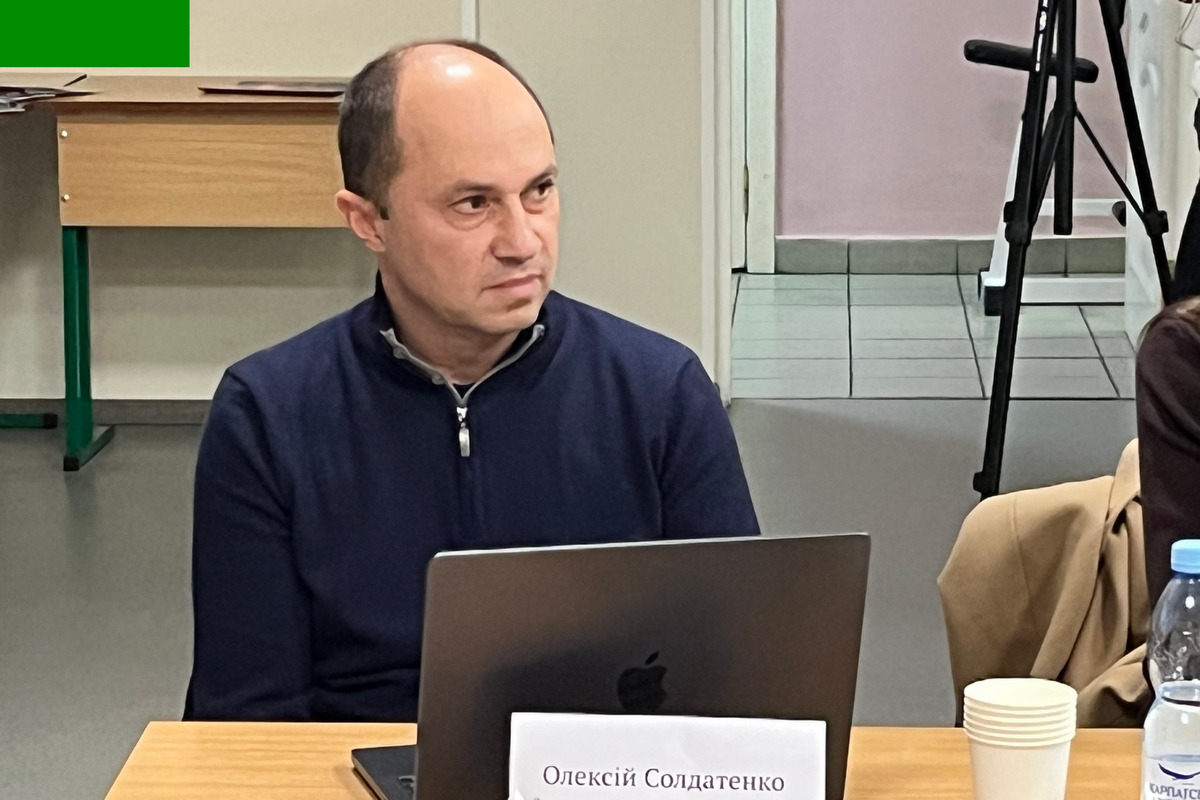
Only 3% of local newsrooms in Ukraine can currently work without serious financial restrictions, Oleksiy Soldatenko, program director of the International Regional Press and Information Institute (IRMI), said at the round table "Media and publishing business during the war" at Grinchenko University . IRMI is a long-standing partner of the NUJU, which supports local media throughout Ukraine.
In 2025, the institute surveyed 226 local and regional media. 89% talked about complete psychological exhaustion, 83% - about a lack of funding, 79% - about a lack of resources and people. These are often newsrooms where everything is pulled by one person, and some saved their media with their own savings.
- Journalism is not a beautiful and easy profession, but a very difficult, tiring and dangerous job for which you must be prepared, - said Oleksiy Soldatenko, addressing students and novice journalists. And he added: - It is the local media that gives people what the national media will not: information about evacuation, humanitarian programs or the work of transport, which is necessary to survive.
Denationalized newspapers have the hardest time surviving: they just started to live according to market rules, when the advertising market disappeared with the beginning of the war. Grants have helped to survive, but this is a temporary solution and international support is dwindling. We have to look for other options. In particular, MykVisti from Mykolaiv opened a reading club and earned 16,000 hryvnias per month in the first two months. There was no need to close materials behind a paywall: people pay for trust and closeness to the editorial office.
Many front-line and occupied communities have moved away, so the newspaper no longer reaches all readers. The editor of the Bakhmut newspaper "Vpered" Svitlana Ovcharenko told about a reader who asked to send her a newspaper by mail: a copy itself costs 15 hryvnias, and delivery - 70. IRMI teaches editorial staff to make quality content for smartphones and wireless microphones, because many have lost premises and equipment.
As Oleksiy Soldatenko pointed out, in the era of hundreds of Telegram channels and bloggers, editors confirm standards through international certification. Some large donors already require such a certificate. In particular, the newspaper "Vorskla" (Sumshchyna) headed by Oleksiy Pasyuga is currently being audited.
The demographic profile of communities is changing rapidly: some are leaving, others are coming. IRMI attracts sociologists, and here, according to Oleksiy Soldatenko, there is great scope for cooperation with universities: students can research the audience of newsrooms during practice.
In general, Oleksiy Soldatenko identified five directions in which local media that seriously care about their development are moving forward:
- from survival to own funds;
- from a newspaper to a multimedia editorial office;
- from verifiable trust to monetizable trust;
- from intuition to data (when editors rely not on their own feelings, but on a deep study of audience requests);
- from coverage to participation in community life (when solution journalism becomes an important vector).
As the survey showed, 70% of the audience wants positive news. It's not about entertainment, it's about "light at the end of the tunnel": solutions that have worked in other communities and countries. For example, the Bakhmut newspaper, whose readers are scattered all over the country, became a platform for talking about what Bakhmut will be like after liberation.
Responding to Oleksiy Soldatenko's speech, Serhiy Tomilenko, head of the NUJU, noted that front-line newsrooms often become leaders in the transformation and development of digital platforms: "They are in ruins, so they are less conservative, more creative."
Information service of NUJU