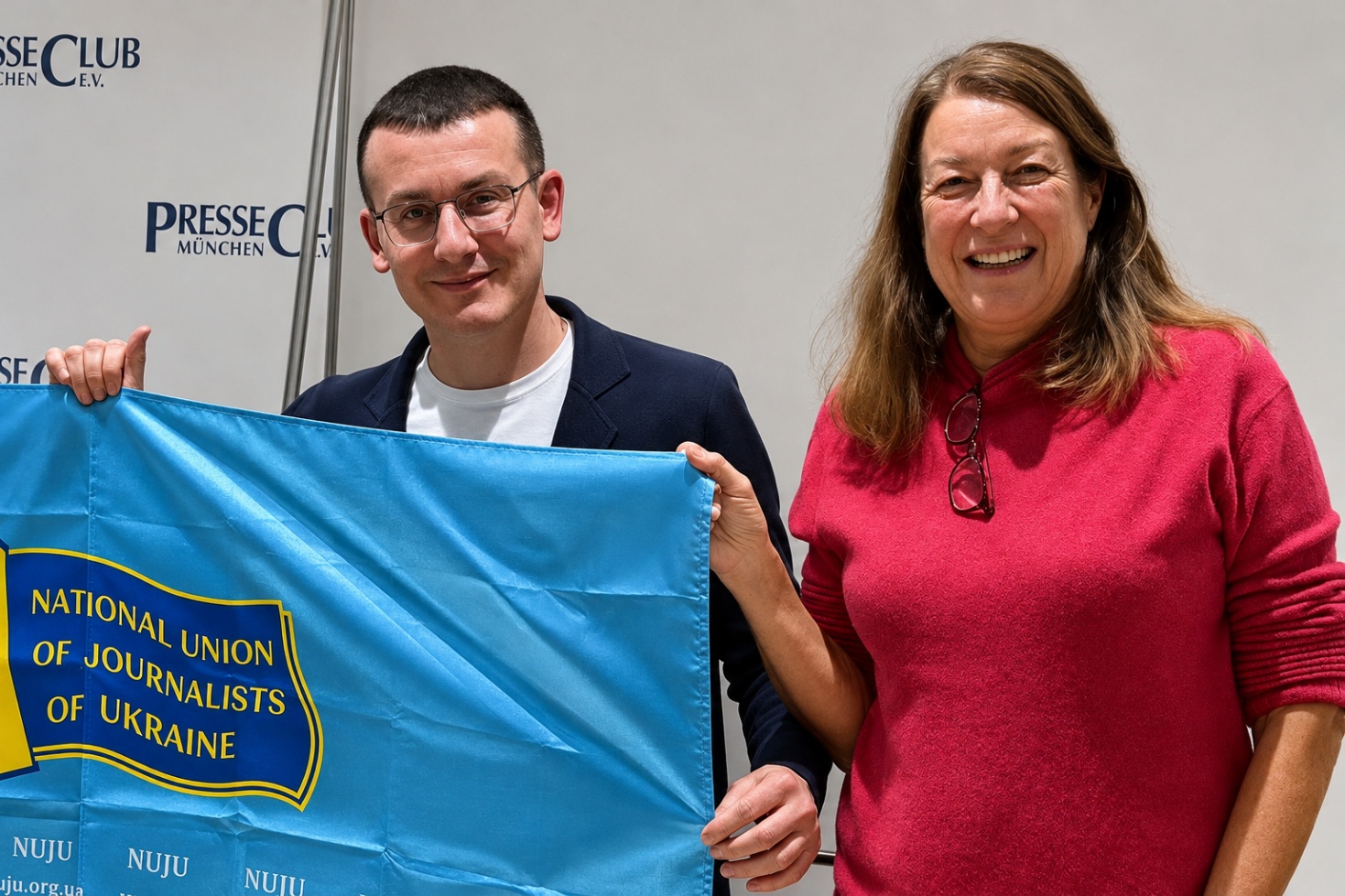
“We are exhausted and it would be unfair to say otherwise. But we continue to work." These words of the head of NUJU Serhiy Tomilenko, according to the confession of the vice-president of the Bavarian Association of Journalists (BJV) and member of the Steering Committee of the European Federation of Journalists Andrea Roth, are always with her.
- Exhausted, but still here and still working. It means a lot to me, she said, joining the round table "Media and publishing business during the war" at Grinchenko University online. - Ukraine is not so far from Munich. Many Ukrainian families found a new home in Germany. For us, this war is not abstract, - stressed Ms. Andrea, who this year became one of the founders and founders of the International Advisory Board of the Centers of Journalistic Solidarity of the National Academy of Sciences .
Solidarity, she says, is the essence of the work of journalists' unions: when a colleague is attacked because of his work, it affects everyone.
- Germany knows what it means when the free press is silenced. Our history imposes responsibility on us, added Andrea Roth.
According to Andrea Roth, the help of the German unions is primarily practical. The head of the German Association of Journalists (DJV) Mika Boister himself came to Kyiv this year and brought important information to Germany: Ukrainian journalists still lack women's body armor.
- Bulletproof vests made for male colleagues simply do not suit them. This worried us the most. We didn't know that, she admitted.
DJV and BJV are collecting donations for Ukrainian media projects. Two weeks ago, at a meeting of union members, colleagues collected funds for Ukrainian journalists.
- This shows that Ukraine has not been forgotten. Our colleagues understand that even a small amount can keep a local newspaper alive, says Andrea Roth.
She admitted that someone who sleeps in a safe bed cannot fully understand Ukrainian colleagues. But German journalists try to do it by listening. They know that FPV drones can reach journalists 30 kilometers from Russian positions, that burnout is also a safety issue, and that a paper newspaper can be a lifeline for villages without electricity or the Internet. Therefore, the direct partnership of unions is important: "Union with union, colleague with colleague, without long chains and intermediaries."
As one of the founders of the International Advisory Council of the Centers of Journalistic Solidarity of the NUJU, Andrea Roth highly praised the work of the centers: since 2022, they have received more than 10,000 requests for help. The Council met for the first time on August 24, the Independence Day of Ukraine. She works on a volunteer basis and does not make decisions on behalf of the NUJU, because, according to Andrea Roth, "Ukrainian colleagues know best what they need." The Council became a bridge to international partners.
In its first joint appeal, the International Advisory Council is asking colleagues for help with multi-year funding, preparing centers for winter, purchasing drone detectors, body armor, security measures, and psychological support. Andrea Roth is already appealing to German foundations, and before Christmas, the council, together with the NUJU, is planning a large-scale campaign in European countries: to European institutions, foundations and universities.
- Our Ukrainian colleagues very often remind us that freedom of the press is never guaranteed, - said Andrea Roth.
She does not compare the situation in Germany with Ukraine: there is no war there. But the pressure on the media is growing. The European Center for Freedom of the Press and Media has documented more than 250 physical attacks on journalists there in recent years, with an increasing number of online threats, particularly to journalists' families. Demonstrations are most often attacked, and journalists are again often called the "lying press."
According to her, the result is alarming: fewer and fewer young people want to become journalists. The most vulnerable are freelancers, who are often left with the consequences alone.
That is why German unions give their colleagues legal aid and after every serious attack demand the punishment of the guilty. In Bavaria, the journalists' union together with the government launched a platform where journalists receive legal assistance after online attacks. Unions are also calling on lawmakers to extend the criminal protections that civil servants already have to journalists.
"A journalist is our colleague, wherever he or she is," concluded Andrea Roth.
Information service of NUJU